Saturday, October 1, 2016

When You Set You the Bar Low...

It wasn't even two weeks between returning from Cape Town and me jetting off again. In my defense, this trip was planned for the past year (and finalized two months ago). When planning the trip, I had two serious options for how to get to my first destination, Madrid. Option 1 was to go through Istanbul on Turkish Airlines, which I wanted to do but then there was the attack at the airport and the attempted coup and so Turkey didn't necessarily feel like a great place to travel through, too many unknowns for my liking. So I instead went with Option 2, flying EgyptAir through Cairo. Almost immediately after booking my tickets, people expressed concern. "Cairo International Airport isn't that nice, and you won't want to spend four hours there," they said. Or, "You don't trust Istanbul/Turkey, but you're willing to trust Cairo/Egypt?" I granted them the second point, but the first one got me concerned and I therefore read online reviews of the airport, which panned it for a whole host of problems. Skytrax gives it a 3/10, and comments range from "chaotic and not clean" to "one of the worst travel experiences I've ever encountered" to "so much quality is missing." Seems like people's worry for me was well-founded.

Until I actually got to the airport. My first thought was, "Wow, this is a super nice airport!" I guess when Khartoum International Airport is the comparison (it has a 2/10 on Skytrax), anything looks good. But still. I was expecting a slightly nicer version of KRT, not the beauty that I saw. Not only were there lots of eating options (including a Burger King and a Haagen-Dazs), but the seats were very comfortable and numerous, and I was able to take quick cat naps on them during my four-hour layover. The gates were logically arranged (Side Note: can't say the same for Madrid, which looks like someone said "OK, where's Gate 30?" and then a guy closed his eyes and randomly pointed at a map, and that became Gate 30. And then they repeated the process for Gate 31, and so on.) and the announcements were clear, if a little numerous. I don't speak Arabic, but even I could understand many of the words in the Arabic one, and the English announcements sounded like English. This was completely different from Khartoum, or even Addis Ababa, where the English announcements oftentimes sound like someone who doesn't speak the language is trying his or her best to sound out the words over the PA system.

I'm sure Cairo International Airport has its downsides, and if I flew through it regularly, I wouldn't be so enamored by it. But Khartoum sets the bar low, and I was impressed by how over and above Cairo was of it.

Given that I'm on an Iberian Peninsula adventure, I share the below clip that I am absolutely obsessed with by Fernando Daniel, a contestant on the current season of The Voice Portugal. This was his Blind Audition, or Provas Cegas.

Friday, September 23, 2016

Hiking Table Mountain, and Other Cape Town Activities

After my misadventure in departing Khartoum, I was ready for a week in Cape Town. It was both an amazing time and a terrible time, but all for the same reason. I was getting comfortable in Khartoum, accepting that I can't go to a bar to have a drink, driving down the street requires swerving around tuk-tuks and potholes, and being OK that I don't understand what half the signs in the grocery store say. Khartoum is, therefore, the opposite of Cape Town. So on the positive side, Cape Town was awesome because it let me do things I love to do, and I was on vacation. On the negative side, Cape Town was terrible because it showed me everything I don't have in Khartoum and made me finally understand some of the things I gave up to come to Sudan.

But I powered through, because that's what I do. On Tuesday, the day I arrived, I walked around center city, along the waterfront, and did a tour of Robben Island, which is most famous for being where Nelson Mandela was imprisoned for 18 years. The tour, which lasted about 4 hours total, including the boat rides to and from the island, provided a good overview of apartheid South Africa, but the setup of the tour--requiring to stay on a bus and therefore no room for self-exploration--left some to be desired. I can understand why they do it that way, with most of the main sites spread out, but it was still disappointing to feel like we were just being shuttled from highlight to highlight. The most impactful part of the tour was the ending portion, where a former prisoner on the island told us his story, from the reason he was imprisoned to his work on the island to what he did after he was released. It helped to put a human face on the conditions in the prison.

That was a pretty full day for my first day in-country, so I rested well that night, in large part because I knew I would need to wake up at 5:30am the next day to hike up Table Mountain. Table Mountain is perhaps the image of Cape Town everyone knows. Rising more than 3,500 feet above sea level, it has a nice flat top (hence, "Table") and some relatively steep cliffs to get there. There are no roads to the top, just a cable car and paths. Being of the adventurous type, I hiked it (don't worry, I paid to go with a guide). The 4 hour hike was amazing. Spectacular views and vantage points that kept changing as we went past different cliffs, around new formations, etc. Especially coming on the heels of a full day of walking around Cape Town, my legs and feet were feeling the effort, but it was an incredible experience that I'm glad I had. My group had six others and two guides, so we were a happy group of 9 trekking up the mountain. And the best part was that we were all relatively equal in terms of capabilities, which meant that no one got left behind and no one ended up too far in front. I also discovered that I love scrambling up rocks--with the steep cliffs, occasionally there is no path, so climbing up some rocks is the only way--and I hope to find other opportunities to do that moving forward. But as much fun as the climb was, getting to the top was even better. The views of Cape Town and the surrounding countryside, especially to the south, was well-earned. After a brief walk around the top of the mountain, we went back down, although this time by cable car (we're not stupid!).

This reminded me of Devil's Pool at Victoria Falls!
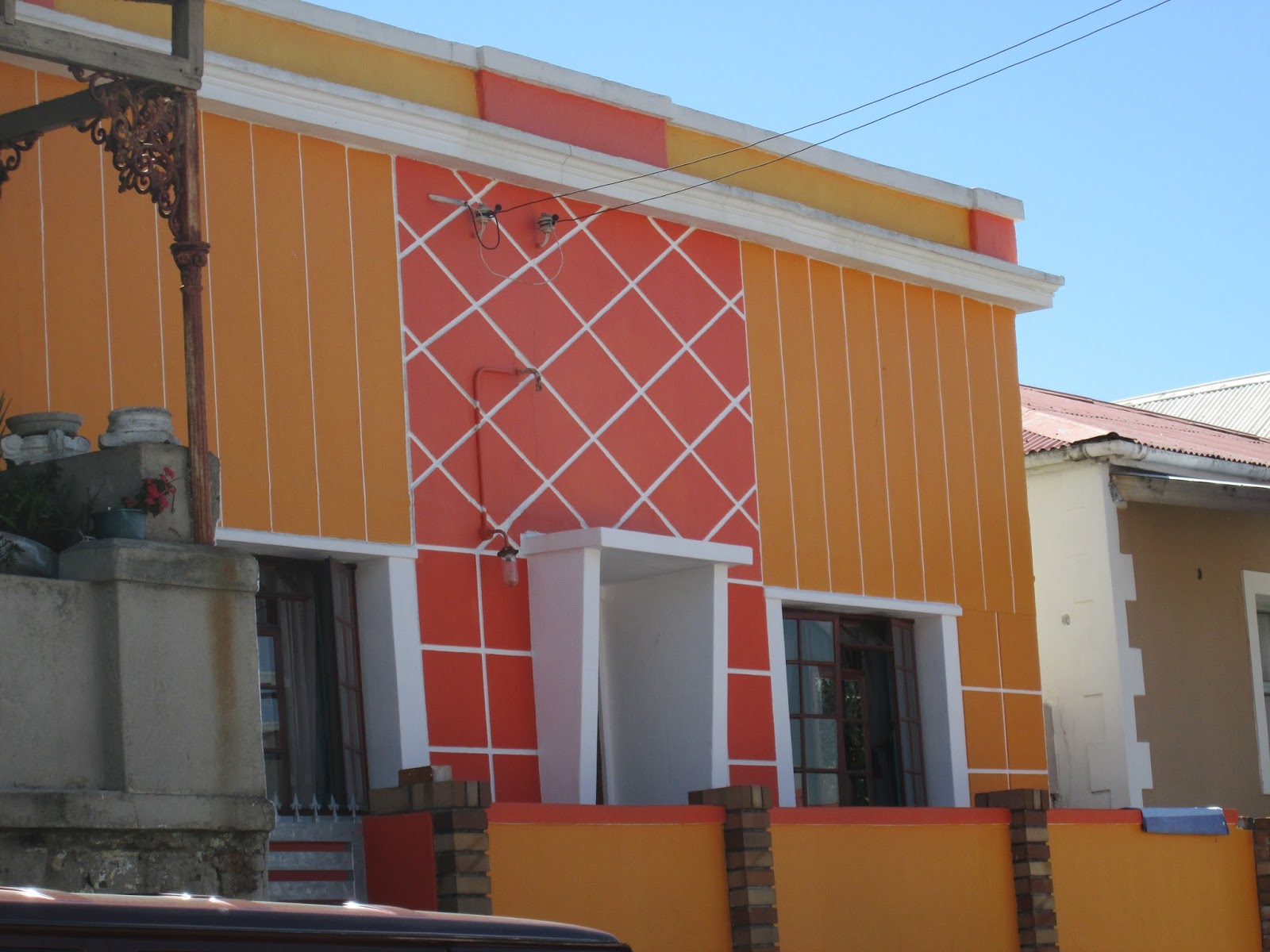
The most unique house, which is saying a lot for Bo-Kaap!
I made it back to my hotel around noon, which was great because it meant I still had a lot of time to do things, but also problematic in that it meant I still had a full day in front of me but no energy. After a brief rest, I set out again for the colorful Bo-Kaap neighborhood (which translates to "Upper Cape"). Bo-Kaap is where the Cape Malays--people from Southeast Asia brought by the Dutch to the Cape Town area--predominantly live. As such, it is a heavily Muslim neighborhood, and I even heard a call to prayer. But what Bo-Kaap is most famous for is the colorful houses on the very hilly streets. There isn't a real reason for the colors. The story goes that residents at some point began painting their houses in the vivid colors rather than the stale white in preparation for Eid, and neighbors conferred with one another on the shades they were using to make sure their houses didn't clash. That tradition has continued, and now it is a very distinct neighborhood!


After wandering the streets of Bo-Kaap for awhile, I eventually ended up at Sea Point, a posh neighborhood. It was in Sea Point that I found Hudson's a burger restaurant. I took a seat at a bar stool around the edge of their outdoor area, overlooking the street (and in the very far distance, the water). As it was a Wednesday night, people were coming in and chatting with their friends, sitting around having appetizers and beers and being social in a happy hour setting. That's when the odd Khartoum life really struck me. I know that in the US I didn't do happy hours with friends all that often, but at least I could do it. Just like in Cape Town, I could. However, in Khartoum, I can't.

With my feet failing me, I called it a night. I woke up late the next day and meandered my way through breakfast. There was one thing left in Cape Town on my "must do" list, so I figured I'd slowly meander my way to it. After a nice saunter along the waterfront, I arrived at Cape Town Stadium. Opened in 2009 in time for the 2010 World Cup, then stadium sits prominently along the waterfront. I opted to pay the fee for an official tour, and as luck would have it, I was the only one on the tour. My private tour of Cape Town Stadium was amazing--I was like a kid in a candy store. We went through the regular seating areas, the VIP areas, the stadium jail, the locker rooms, and eventually walked out the tunnel where players come from and onto the pitch. Well, just shy of the grass (we're not allowed on it). It. Was. Awesome.

For my final day in Cape Town, I rented a car and decided to drive down to the Cape of Good Hope (which I just learned actually isn't the southernmost point in Africa, but I would still like to pretend that it is). The weather cooperated with me for several days, but Friday was not one of them. Temperatures hovered in the upper 40s and low 50s, the wind was howling at 30+ mph, and there was a pelting rain all day. But I don't know the next time I'll get to the area, so I set out anyway. I drove the scenic route to the Cape and made it all the way to the funicular to the lighthouse. I intended on walking up to the lighthouse, but given the weather conditions, decided better of it. I took the funicular up, which still leaves you a few minutes from the lighthouse itself, and then me and about a dozen other tourists just stood there looking, as if all of us were daring the others to go out first. Remember how I said I don't know when I'll be there again?  With that mentality, I took a deep breath and just started going. I walked along all the paths to see where I'd be able to see through the rain and fog to the cliffs below.

I eventually came across a relatively clear-ish view, took the necessary pictures, and then headed back to the funicular and my rental car. While I would have liked to have spent more time there, the weather made it a bad decision, so I drove off and headed back to the airport for my flight home, albeit it with a few detours. The first was to Simon's Town, which is most famous for its boulders and colony of African penguins (I saw some at Robben Island too). Then as I was getting close to the airport, I realized I still was super early, so I drove out into South African wine country, through Stellenbosch, just to see the picturesque scenery (through the clouds and fog), and then made my way to Somerset West, which is also known for its vineyards and looks like a big resort town. Having completed my loop through Cape Town's eastern suburbs, I returned the car at the airport and waited for my not-as-painfully-delayed flight back to Khartoum.

It was a great trip and one of the 10 places I have listed as a Dream Location (the pin in my map has now moved to Lalibela, which was my original destination for this trip before I switched it to Cape Town). I'm glad I was able to pack so much into my four days, although I'm not sure how wise it was for me to take such a culture shock after nearly 4 months straight in Sudan. In any case, I'm happily back in Khartoum and getting readjusted, ready for my next trip out of the country (in just a few days...always planning my next escape!).

In honor of me going to South Africa, here's a video of Trevor Noah I know I've posted before, but it just feels right here!

Saturday, September 17, 2016

Misadventures in Leaving Khartoum

113 days. That's how long I survived in Khartoum before finding a deep need to leave. Among expats here, the general rule of thumb is that you need to take at least a weekend trip out of the country every 90 days. At the 108 day mark, the Government of Sudan declared that the Eid al-Adha holiday would last from Sunday to Thursday, creating a 9-day weekend. That was the only signal I needed to book a last-minute trip to Cape Town. For being so last-minute the trip was reasonably well-planned. I had one connection for two hours, I found a relatively cheap hotel, I was able to schedule my "must-dos" across my few days.... However, Khartoum made a valiant effort to thwart this vacation.

I arrived at the airport around 2:30 AM for a 4:30 flight. At 4:00, we boarded the bus to the plane and the bus inched forward before stopping. For 30 minutes. The airport staff then ordered us off the bus and back into the terminal while "mechanical issues" were being fixed. Not to worry, they assured us, it's not that hard and we'll all make our connections in Addis Ababa. 4:30 turned to 5:00 turned to 5:30, and we're instructed to leave the gate area and to go back to the holding room. 6:00 rolled around and they told us that we can have free food and drinks from the airport's very sad-looking cafe. As time went on, I started becoming friends with an American teacher and her Colombian husband who only recently arrived in Khartoum. We reached 7:00 and it became obvious that no one was going to make his or her connection. Impatience among the passengers became more visible and audible as the airport staff sent us to Ethiopian Airlines staff for assistance, but they retreated into a closed office. By 8:00, we were told that a manager from Ethiopian Airlines' Khartoum office was on his way in.

The manager arrived at 8:30 and told us that there is a part they need from Addis Ababa, but once they have it, it will only take 15 minutes to put it in and then we'll be on our way. The next flight from Ethiopia was scheduled to arrive at 11:30, so overall, not long after that. Given the delay, the airline (the airport?) opted to send us to a hotel to relax, get breakfast, etc. The story seemed plausible until the "go to the hotel" part because it seemed like a big expense and a lengthy endeavor for something that would be fixed quickly. Mayhem ensued as people started yelling in Arabic, and this is when we met a young girl from Sudan also on our flight. As she spoke fluent Arabic and English, she was very helpful in figuring out what was going on. At 9:00, we were ushered out near the immigration counters.

If you think this story is starting to fall in-line, you're very wrong. See, Sudanese immigration officials didn't want to let us back into the country, meaning we were officially stuck. As explained to us, a deal was struck whereby we'd be allowed to leave the airport, and judging from the extra stamps in my passport, it looks like they effectively cancelled our exit stamps. Oddly, when we eventually did leave later in the day, the afternoon immigration officials appeared puzzled by what the morning ones did. You'd think someone would've told them....

As 10:00 approached, everyone on the flight had a cancelled exit stamp and we were sent back to the check-in area to wait for a bus to take us to the hotel. And we waited and waited, as the bus could only hold so many people and was making trips back and forth to the hotel. I got on the last bus, but I think we might have almost missed it because we were instructed to wait inside, and at some point, it was just me and my 3 new friends inside. With luck on our side (for once), we arrived at the hotel just after 10:45. Realizing that Ethiopian Airlines kept us in the dark so much, we asked the hotel manager if he was told how long we'd stay. Hearts sank when he said he was informed that we might be there overnight. He quickly amended that to "worst case scenario," but the damage was done. Seeing our faces, he suggested we go have breakfast at their buffet, which was about to close but which the hotel was nice enough to keep open--and restock--for us. After several hours in the airport, the open air and flaky croissants were heavenly.

At 12:30, I asked the front desk if they had any more information. The woman said she didn't but she would call all the rooms if there was any good news. Knowing that the adrenaline that powered me since 2:00 wouldn't last, I decided to take a nap. It was a rather restless nap, however, because I became paranoid that I would miss the phone call or the knock on the door and then I'd be stranded in Khartoum (never mind that I could, you know, go home if this dragged on endlessly). I woke up violently at 2:00 (PM this time) and called the front desk. Ta-da! The bus was downstairs and ready to take us back to the airport. I quickly repacked my things and went back to the airport for try number 2.

Things went relatively smoothly at this point, all things considered. We re-boarded the bus at 4:00 PM and took off just over 12 hours delayed. Thankfully Ethiopian Airlines has two flights per day to South Africa (one Cape Town to Johannesburg, the other the reverse), so I was able to catch the second one the long-way around after another long delay in Addis Ababa. But given the circumstances, I'm surprised I arrived at my destination only 18 hours late. It did mean my planned 12-hour journey took 30 hours, but given that I slept VERY well on my flight, I was well-rested and ready to start my day in Cape Town when I arrived at 7:15 AM.

Following my leaving Khartoum misadventure, I'm of mixed mind on the "leave every 90 days" mantra. On the one hand, it's experiences like these that make me go crazy and yearn for Western "normalcy." However, while people said the magnitude of this delay was abnormal, the general experience was quite common, and I don't know if I'd have the energy to go through it again. I have another trip in two weeks, so I hope it goes more smoothly!

UPDATE: This was written (but not posted) before I returned, and my bad luck continued on my journey home. On the flight out of Cape Town, we were delayed 90 minutes because the plane didn't have enough power to start the engine. On the positive side, I still made my connection back to Khartoum and arrived about 20 minutes early, in fact.

The delay would've have been nicer if we were treated with some entertainment like this! Why don't these things ever happen when I'm around???

Monday, August 29, 2016

Rio 2016 Recap

Now that the Rio 2016 games are over, it's time for a little recap. Can't wait until Pyeongchang 2018, Tokyo 2020, and Beijing 2022! :)

1.     88 countries won Olympic medals, and only 1* is non-independent (Puerto Rico, and then there are Kuwait's medals which count for Independent Olympic Athletes).
2.     69 countries won at least one bronze medal. 63 countries won at least one silver medal. 59 countries won at least one gold medal.
3.     The US won the most medals overall, at 121, followed by China (69), Great Britain (67), Russia (56), and Germany (42).
4.     The US won the most gold medals, at 46, followed by Great Britain (27), China (25), Russia (19), and Germany (17).
5.     The US won the most silver medals, at 37, followed by Great Britain (23), and ChinaFrance, and Russia (18 each).
6.     The US also won the most bronze medals, at 38, followed by China (26), Japan (21), Russia (19), and Great Britain (17).
7.     There were 306 medal ceremonies, giving out 306 golds, 306 silvers, and 359 bronzes. If you disaggregate the medals (i.e., multiple medals for teams/groups), 663 gold medals, 655 silver medals, and 702 bronze medals were handed out.
8.     1,853 athletes (about 100 less than 2012) received some sort of medal during the games, or 16.28% of all athletes who went to the games.
9.     Medals were handed to US athletes 262 times. Second was Germany, with 162, Great Britain (145), Russia (115), and China (113).
10. 138 gold medals were handed out to the US, followed by Great Britain (64), Russia (52), Germany (50), and China (46).
11. 55 silver medals were out to Great Britain, followed by the US (54), France (51), Germany (45), and Italy (40).
12. 70 bronze medals were handed out to the US, followed by Germany (67), Canada (60), China (37), and Japan (35).
13. The US had the most athletes walk home with at least one medal, at 209. Following the US was Germany (154), Great Britain (130), Russia (103), and China (100).
14. But not every country had a lot of athletes. So in terms of percentage of athletes who got medals, 52.43% of Serbian athletes won medals, followed by Jamaica (40.68%), Russia (38.01%), the US (37.73%), and Germany (36.32%).
15. Of countries that won medals, the worst percentages were Portugal (1.09%, or 1 of 92 athletes), Algeria (1.56%, or 1 of 64 athletes), India (1.61%, or 2 of 124 athletes), Finland (1.82%, or 1 of 55 athletes), and Morocco (2.04%, or 1 of 49 athletes).
16. None of Serbia's 54 medalists won more than one medal. Same goes for Croatia (24), Belgium (21), Argentina (20), and Norway (19).
17. In a note of futility, none of Chile's 42 athletes won a medal. Other countries with more than 30 athletes but no medals include Ecuador (38), Hong Kong (38), Latvia (34), Montenegro (34), and Zimbabwe (31).
18. Mexico's 5 medals are the most without a gold (3 silver, 2 bronze). Norway's 4 medals are the most without a silver (all bronze), and Argentina's (3 gold, 1 silver), Slovakia's (2 gold, 2 silver), and Armenia's (1 gold, 3 silver) 4 medals each are the most without a bronze.
19. Six countries--FijiJordanKosovoPuerto RicoSingaporeTajikistan--won 1 gold medal and nothing else.
20. Two countries--IrelandAlgeria--won 2 silver medals and nothing else. Five countries--BurundiGrenadaNigerPhilippinesQatar--won 1 silver medal and nothing else.
21. One country--Norway--won four bronze medals and nothing else. Two countries--EgyptTunisia--won three bronze medals and nothing else. Eleven countries--AustriaDominican RepublicEstoniaFinlandKyrgyzstanMoldovaMoroccoNigeriaPortugalTrinidad and TobagoUnited Arab Emirates--won 1 bronze medal and nothing else.
22. Belgium and Thailand each won 2 gold, 2 silver, and 2 bronze medals.
23. Latvia and Turkmenistan are the only former Soviet Republics not to win a medal.
24. On average, each Nigerian medal was for 18 athletes (Nigeria's only medal was for its 18-member Men's Football team). Similarly, each Fijian medal went to 13 athletes. The highest number of athletes on average otherwise are Serbia (6.75 athletes/medaling event), Argentina (5.00 athletes/medaling event), and Norway (4.75 athletes/medaling event). The US was 24th, averaging 2.17 athletes per medaling event.
25. Eleven delegations of less than 20 athletes won medals. The smallest were Grenada and Niger (6 athletes entered), followed by Tajikistan (7), Jordan (8), Kosovo (8), Burundi (9), Independent Olympic Athletes (Kuwait) (9), Cote d'Ivoire (12), Philippines (13), United Arab Emirates (13), and Kyrgyzstan (19).

Also, NBC's coverage of the Olympics was ridiculous. And if you need proof, watch John Oliver's take on it.

Friday, August 5, 2016

It's Olympics Time!

The Olympics come once every four years, and the Opening Ceremony is, perhaps, my favorite event of every Olympic cycle. Even though the Opening Ceremony will begin at 2am local time, I am staying awake to watch the 3.5 hour ceremony. And it will be totally worth it.

Like in 2012, I will be working to make an Olympic Fact of the Day. These are weird facts that really dig into what is considered "useless facts." As a taste of what these might be like, here are the 2012 facts:

Saturday, July 28: On the first day of competition, Kazakhstan won a gold medal, but Great Britain didn't win any.

Sunday, July 29: 7 of the 16 remaining female table tennis players represent European countries. Only 2, however, were not born in China (1 each for Belarus and Romania).

Monday, July 30: 15-year old Ruta Meilutyte of Lithuania won all three rounds of the 100m breaststroke by swimming her three fastest times ever: in her heat (1:05.56), in her semifinal (1:05.21), and in the final (1:05.47).

Tuesday, July 31: Qatar won its third bronze medal in Olympic history today. Nasser Al-Attiyah, however, is the first of the three born in Qatar (the two previous medalists were born in Somalia [1992] and Bulgaria [2000]).

Wednesday, August 1: Only 1 European squad, Great Britain, is in the Men's Football quarterfinals; the only other time in Olympic history that only 1 European team made it to the quarterfinals was 2004, when Italy represented the continent. This excludes the 1904 Olympics, when the football tournament only feature 1 Canadian and 2 American teams.

Thursday, August 2: Of the top 4 female gymnasts in the all-around, 2 are Christian, 1 is Jewish, and 1 is Muslim.

Friday, August 3: Lee Wai Sze of Hong Kong's bronze medal in Women's Keirin Cycling was the first for a non-independent country in the 2012 Olympics.

Saturday, August 4: Binnaz Uslu of Turkey finished 15th in her heat for the 3000m Steeplechase, more than 30 seconds after 14th place and approximately 1 minute past the qualifying time for the finals.

Sunday, August 5: Synchronized Swimming is one of only two Olympic events--with Rhythmic Gymnastics--in which only women compete.

Monday, August 6: Daniyal Gadzhiyev's bronze medal in Men's 84kg Greco-Roman Wrestling was Kazakhstan's 7th medal of these Olympics, but its first non-gold.

Bonus Fact: Grenada and Cyprus joined Guatemala in winning their first ever Olympic medals today. Grenada's Kirani James won gold in the Men's 400m, while Cyprus's Pavlos Kontides won silver in Laser Sailing. Erick Barrondo of Guatemala won silver in the Men's 20km Walk on Saturday.

Tuesday, August 7: Three bronze medals were awarded in the Men's High Jump--one each for Canada, Great Britain, and Qatar. The event, which has been contested in every Olympics since 1896, has only had three bronze medalists one other time (1992), although there were three silver medalists at the 1908 Games.

Wednesday, August 8: Great Britain didn't win any medals today, the first time that's happened since the first day of competition.

Thursday, August 9: Of the 7 sports that have pool play prior to the knockout stages, US women have won gold medals in 3 of them (beach volleyball, soccer, water polo) and are in gold medal matches in 2 others (basketball, indoor volleyball) on Saturday. The US women's field hockey team plays to not be in last place tomorrow, and the US didn't enter a team for handball.

Bonus Fact: 29 bronze medals were handed out today to 26 different countries (Italy, Kazakhstan, and the US each got two).

Friday, August 10: The Rhythmic Gymnastics competition is dominated by Eastern Europeans. Of the 10 finalists, 2 represent Russia, 2 are from Ukraine, and 1 each from Azerbaijan, Belarus, Bulgaria, and Poland. Israel's Neta Rivkin was born to Russian emigres. The lone exception (sort of) is South Korea's Son Yeon-Jae...who trains in Russia.

Saturday, August 11: The finals of the Women's K-1 200m Canoeing race featured two women named Teresa Portela. Portela of Spain finished fourth, while Portela of Portugal finished eighth.

Sunday, August 12: A Gabonese man has won the country's first ever medal.

And 27 fun wrap-up facts about the medals:

  1. 85 countries won Olympic medals, and only 2 are non-independent countries (Hong Kong and Puerto Rico).
  2. 71 countries won at least one bronze medal. 65 countries won at least one silver medal. 54 countries won at least one gold medal.
  3. The US won the most medals overall, at 104, followed by China (87), Russia (82), Great Britain (65), and Germany (44).
  4. The US won the most gold medals, at 46, followed by China (38), Great Britain (29), Russia (24), and South Korea (13).
  5. The US won the most silver medals, at 29, followed by China (27), Russia (25), Germany (19), and Great Britain (17).
  6. Russia won the most bronze medals, at 33, followed by the US (29), China (22), Great Britain (19), and Japan (17).
  7. There were 302 medal ceremonies, giving out 302 golds, 304 silvers, and 356 bronzes. If you disaggregate the medals (i.e., multiple medals for teams/groups), 639 gold medals, 635 silver medals, and 684 bronze medals were handed out.
  8. 1,958 athletes received some sort of medal during the games, or 18.27% of all athletes who went to the games.
  9. Medals were handed to US athletes 256 times (including instances like 18 female soccer medals). Second was Russia, with 140, Great Britain (126), China (124), and Australia (114).
  10. 147 gold medals were handed out to the US, followed by China (56), Russia (50), Great Britain (48), and Germany (45).
  11. 63 silver medals were out to the US, followed by Japan (44), China (40), Russia (38), and Australia (37).
  12. 59 bronze medals were handed out to Australia, followed by Russia (52), Great Britain (48), the US (46), Japan (33), and Canada (33).
  13. The US had the most athletes walk home with at least one medal, at 208. Following the US was Russia (129), Great Britain (114), China (102), and Australia (99).
  14. But not every country had a lot of athletes. So in terms of percentage of athletes who got medals, 45.45% of Montenegrin athletes won medals, followed by Trinidad and Tobago (43.33%), the US (39.25%), Jamaica (38.00%), and the Netherlands (35.96%).
  15. Of countries that won medals, the worst percentages were Venezuela (1.43%, or 1 of 70 athletes), Morocco (1.49%, or 1 of 67 athletes), Egypt (1.77%, or 2 of 113 athletes), and Hong Kong and Algeria (both 2.38%, or 1 of 42 athletes).
  16. None of Brazil's 59 medalists won more than one medal. Same goes for Canada (55), Croatia (35), New Zealand (27), and Mexico (26).
  17. In a note of futility, none of Austria's 70 athletes won a medal. Other countries with more than 30 athletes but no medals include Nigeria (55), Israel (37), Ecuador (36), Chile (35), Angola (34), Cameroon (33), and Senegal (31).
  18. India's 6 medals are the most without a gold (2 silver, 4 bronze). North Korea's 6 medals are the most without a silver (4 gold, 2 bronze), and Switzerland's 4 medals are the most without a bronze (2 gold, 2 silver).
  19. Five countries--Algeria, Bahamas, Grenada, Uganda, Venezuela--won 1 gold medal and nothing else.
  20. Six countries--Botswana, Cyprus, Gabon, Guatemala, Montenegro, Portugal--won 1 silver medal and nothing else.
  21. Four countries--Greece, Moldova, Qatar, Singapore--won 2 bronze medals and nothing else. Seven countries--Afghanistan, Bahrain, Hong Kong, Kuwait, Morocco, Saudi Arabia, Tajikistan--won 1 bronze medal and nothing else.
  22. Tunisia is the only country that won 1 gold, 1 silver, and 1 bronze medal.
  23. Kyrgyzstan and Turkmenistan are the only former Soviet Republics not to win a medal.
  24. On average, each Montenegrin medal was for 15 athletes (Montenegro's only medal was for its 15-member Women's Handball team). Similarly, the Bahamas's 10gold medal went to 6 athletes. The highest number of athletes on average otherwise are Croatia (5.82 athletes/medaling event), Argentina (4.75 athletes/medaling event), and Norway (4.50 athletes/medaling event). The US was 19th, average 2 athletes per medaling event.
  25. Eleven delegations of less than 20 athletes won medals. The smallest was Botswana (4 athletes entered), followed by Afghanistan (6), Grenada (10), Kuwait (11), Qatar (12), Bahrain (12), Cyprus (13), Uganda (16), Tajikistan (16), Guatemala (19), and Saudi Arabia (19). Of these, Saudi Arabia had the most athletes win a medal (4 athletes in one event), but Qatar is the only one to win a medal in more than one event.
  26. By continent, Africa won 34 medals (11 gold, 12 silver, 11 bronze). Asia won 243 medals (79 gold, 72 silver, 92 bronze). Europe won 441 medals (133 gold, 145 silver, 163 bronze). North America won 166 medals (61 gold, 47 silver, 58 bronze). Oceania won 48 medals (12 gold, 19 silver, 17 bronze). South America won 30 medals (6 gold, 9 silver, 15 bronze).
  27. By Regional Grouping: The Western Hemisphere won 196 medals (67 gold, 56 silver, 73 bronze). Middle Eastern countries won 29 medals (8 gold, 10 silver, 11 bronze). Sub-Saharan Africa won 27 medals (9 gold, 9 silver, 9 bronze). Countries of the former Soviet Union won 164 medals (47 gold, 44 silver, 73 bronze). Countries of the former Yugoslavia won 15 medals (5 gold, 4 silver, 6 bronze).